Housewife's Song, Three Years Later
"Housewife's Song" is something like a story I wrote three years ago. The plot is roughly about a son, who, like me, suffers from a nostalgic disposition, reminiscing about his mother, who had once loved another woman. The reason why out of all the possible topics I could've written this somehow became the one for me was simply that I was extremely fascinated by love between women at that time (and still am now); it had nothing to do with me personally having such a mother, as I don't have one. Even if I did, as her son, I wouldn't be in a position to want to delve into it.
There's something in English that should probably be called "decadence", which roughly means artistic regression. In my view—at least at the time—I felt that combining nostalgia and decadence created a heart-wrenching kind of beauty. The idea that something beautiful once existed, untouched by destruction, but simply faded away with time; as these things disappear, no one notices; when they are finally gone, it's too late to recover them; all of this had a poignant allure. I've always found myself yearning for this sensation, especially during times when the gap between the past and my present reality felt overwhelming; this sense of loss born of contrast between the two lingers and captivates me endlessly.
I'm not sure if my preference for Western-style architecture is related to this—or if it's simply because I'm utterly weary of traditional Chinese architecture. In childhood, family outings to parks inevitably featured pavilions with Chinese-style roofs. My mother always said they were elegant and carried an "ancient charm." However, this so-called ancient charm, while not ubiquitous, was still extremely common: many roadside shops have uniform signs with fake classical Chinese motifs (they are not even genuinely classical, but imagined replicas born from modern interpretations of tradition). These structures never lifted me off the ground; they seemed uninterested in doing so, only repeatedly asserting their identity as "traditional Chinese culture" - or maybe it was only my mom doing the asserting, because buildings can't speak. I can't get high off this kind of things.
The story was written during a winter break when I was at home. Not long after returning to school, I visited Shamian Island. The island, filled with Western-style buildings dating from the Republic of China or even earlier, was a dream destination for someone like me. Now that I remembered, there was even a primary school on the island—what a lucky group of kids, how I'd have loved to attend primary school in such a place. That day, I took many photos on the island. One building was under renovation, covered in scaffolding—I wonder how it looks now. The next day, or maybe the day after, I visited the ballroom described in the story—or rather, its real-life prototype:
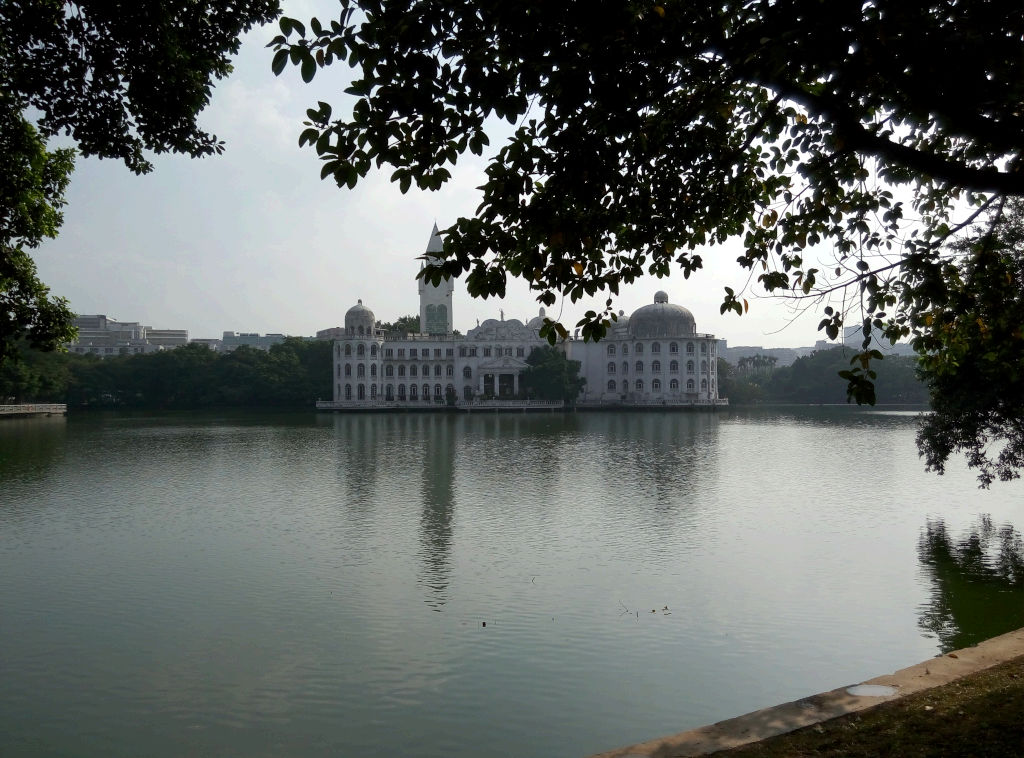
But the actual ballroom wasn't here. I'm not sure what this building is used for—I only knew that it occasionally served as a backdrop for wedding photos. It was situated in a park, where during family visits I could often see couples in suits and wedding dresses. Beyond that, I know little about it. Here's the real ballroom. I didn't even film it properly; maybe it was too much of a disappointment (or perhaps I just didn't want other tourists in the photo):
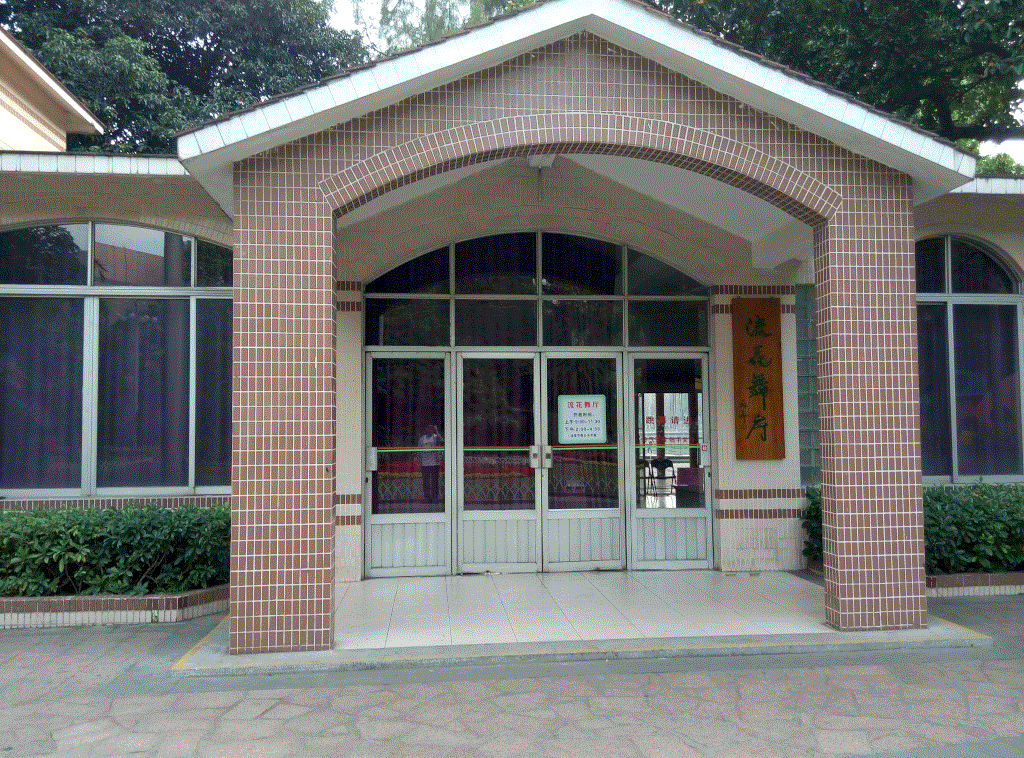
(Yes, that's my reflection on the door.)
When writing the story, my memories of these places blended together. When I stood before it in real life, I felt quite let down.
The church school in the story was inspired by "FLOWERS", a visual novel series titled after the four seasons: spring, summer, autumn, and winter. Recently I replayed the summer chapter, and I realized how different it feels - it was a completely different sensation to play in my dorm room in Canton City and to play in my apartment in Shenzhen. Of course, my life and circumstances have changed completely since I wrote the story, so having a different perspective is only reasonable. However, unlike Canton City, Shenzhen doesn't have its own Shamian Island; and now, due to the pandemic, I can't freely move about, unlike in Canton City where all it took was a bit of time and a ten-yuan round trip to visit. That contrast adds a bittersweet sting to the smooth, mellow sense of decadence: beauty that once seemed so accessible now feels out of reach. I suppose this gap is itself a kind of decadence. Also, back then I constructed a metaphorical tower of decadence in my stories; but now, my life in Shenzhen feels like it's sweeping away all the accumulated dust, casually pushing the tower into a corner. The loss of the sense of melancholy itself evokes a subtle new sense of loss, and maybe that new kind of loss too can be something that's enjoyable; yet this never bring any of the former pleasure of suffering, only leaving a lingering bitterness on the tip of my tongue. Even so, three years later, I still crave for this inexplicable sensation. Perhaps there's no saving me. I feel this craving for decadence as an intrinsic part of myself, evident not just in writing but in daily life. How many others in this world still long for that skipped heartbeat when encountering such things?
Speaking of decadence, I remember something else. During the National Day holiday in 2018, I decided I shouldn't spend the entire break in my dormitory, so I went to Bio-Island, imagining it was a zoo or botanical garden; upon arrival, I found it was actually a biotechnology industrial park. That day, I walked along the island's edge and took this photo:
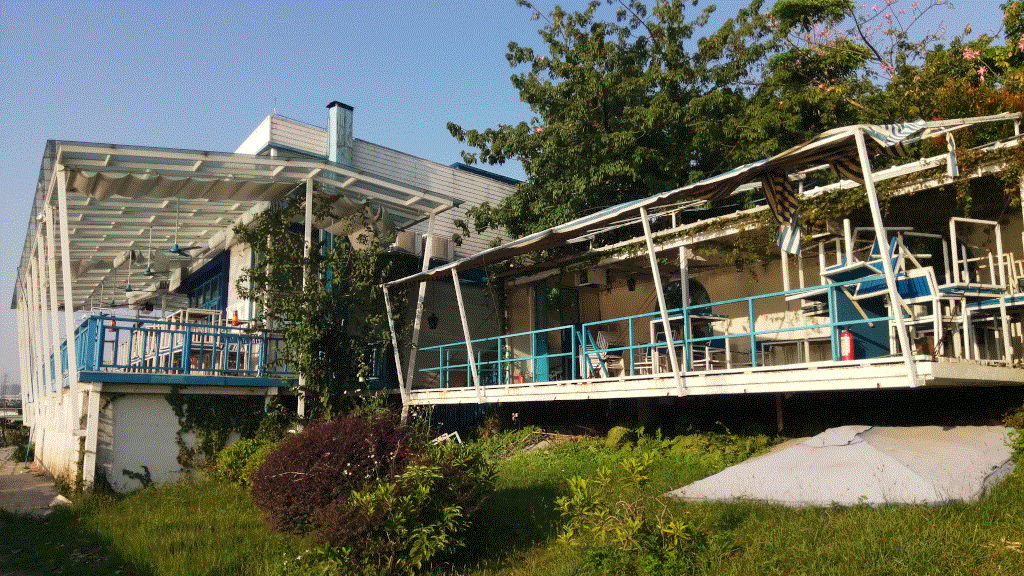
This was just a broken-down restaurant and bar. Although there were grander buildings on the island, I specifically photographed this one and particularly liked it. Now that with all the things mentioned above, I suppose I really don't need to explain why I did. Still, only now do I realize: I visited Bio-Island during a holiday. Even if this place was operating, it would have been empty because the island itself isn't a tourist destination. So, was the decadence I imagined just my wishful thinking? If that's true, it doesn't bother me. Novels based on feelings only I can sense will naturally only appeal to me. It's no surprise if others don't like them.
This retrospective was originally written for myself. But I suddenly remembered a former friend, N, who once said they looked forward to a sequel. Back then, I carelessly promised there would be a sequel, even if I likely cannot come up with one. Let's assume there really will be a sequel; writing is difficult, especially when life is going well and there's little incentive to prick one's own heart and make it sensitive again; it would require years for the sequel to complete. But even if I regain sensitivity, so what? My life is so monotonous, filled only with work and sleep, what could I even write? For now, I can only collect fragments of occasional thoughts, hoping to have enough of them to piece into another story someday.
In 2017, there was a Yuri-themed event in Guangzhou I could have attended. For reasons I've since forgotten, I didn't go. Now, as I sit in my Shenzhen apartment, writing this conclusion for this retrospective, I can't help but wonder if things would have been better if I had.
P.S.: Recently, I've taken a liking to Ivan Lins. Initially, I discovered him through samples used by Nujabes, but his other works are excellent too. Somos Todos Iguais Nesta Noite is particularly good. As for the sequel that I'm writing - or piecing, I didn't intend for the protagonist to be the same person; but if the story somehow still makes sense after assuming that to be true, then same person they shall be.
P.P.S.: Not long ago, a colleague mentioned encountering N on Telegram, mistaking them for me. I don't use Telegram. I wonder how N is doing now.
P.P.P.S.: Before the Lunar New Year, I planned to visit Macau—not for any specific reason but to see the colonial-era relics. However, due to the pandemic, I'm unsure when this will happen.
© Sebastian Higgins 2020 All Rights Reserved.
Content on this page is distributed under the CC BY-NC-SA 4.0 license unless further specified.
Last update: 2020.4.14